Pythia · Sovereign AI
Everything your business holds, readable. Without any of it leaving the building.
Every business keeps more written material than anyone can read. Invoices, CVs, supplier certificates, contracts, signed delivery notes, photographs of paper, fifteen years of email. The answers are in there. Finding one is somebody's afternoon, every time.
Pythia reads all of it and answers questions from it, and it runs on a computer you own, in your building. No cloud account, no upload, no file going anywhere. For a lot of businesses that is not a preference. It is the condition of doing the work at all.
Your hardware · Nothing uploaded · 30 minutes
What it actually is
A machine that has read everything
Your files · Not the internet
Point it at your shared drive, your accounting system, your email archive. It reads what is there, including the scans and the photographs of paper, and it answers from those files rather than from whatever a model happens to know.
A box in your building
Your hardware · Your network
It sits on hardware you own, on your own network. Nothing is uploaded and there is no account to cancel. If your internet goes down, it keeps working.
It shows its working
Every answer, sourced
Every answer comes back with the document and the page it came from. Nobody has to take it on trust, and a new starter can check it.
Jobs it does
The work somebody is already doing by hand
Six jobs, in six different departments. None of them is exotic. All of them are somebody's week.



Invoices for payment
Accounts payable
Supplier invoices arrive as PDFs, as scans, as photographs taken on a phone. Each one has to be matched to a purchase order, checked against the rate that was agreed, and stopped if it is a duplicate or the VAT is wrong. What comes back is the short list a person actually needs to look at.
CVs and applications
Recruitment
Twelve hundred applications, five channels, six jobs, and no two written the same way. The rules go down in plain language before anything arrives. Then every application is screened against them, and every no carries the rule that stopped it.
Paper and scans
Reading what was never typed
Delivery notes, signed forms, a certificate that arrived as a photograph. It reads them, pulls out the fields that matter, and tells you which ones it could not read rather than guessing at them.
Quality and supplier records
ISO 9001 · EN 9100
A twelve-person machine shop with three hundred documents and an auditor coming. Which certificates have lapsed, which procedure was never signed, which non-conformity has no closure record against it.
Regulatory returns
Reporting
Sixty-two thousand rows out of the core system every quarter, and some of them are wrong. Eight rules decide what can be reported, and somebody has to be able to defend every figure in it.
Checking against a standard
Compliance
Plans and documents checked against a published rulebook, with every finding traced back to the clause it came from.
Four of these you can open or watch, and they are linked above. The other two are the same shape of work, described: we have not recorded a run of either, and would rather say so than let a number imply one.
And the monthly report nobody has time to run. The database you already own, asked a question directly instead of exported to a spreadsheet once a month and rebuilt by hand. That one is worked through in full on the home page.
Read it thereThree you can watch
Three of the jobs above were recorded on an ordinary desktop machine. The longest took just over three seconds. Press the button and watch one happen.
Why it runs in your building
Four different reasons, one identical constraint
Some businesses cannot send their files anywhere at all. A law firm cannot, because privilege forbids it. A manufacturer cannot, because the standard is licensed and the drawings are export-controlled. A clinic cannot, because of the patients. An accountant cannot, because of the clients. The reasons have nothing to do with one another. The constraint is the same one every time: the documents stay in the building.
What sovereign means here. The data, the machine it runs on, and the decision about what happens to either one all belong to you. Not a clause in somebody's contract and not a setting in somebody's preferences page. A fact about where the wires go.
Privacy, obviously
On-premise is not a setting somebody switches on in a preferences page. It is an architecture, and it is either true of your system or it is not.
It does not change under you
A cloud service is updated on somebody else's schedule, and a process that was defensible in March can quietly stop being so in June. A system on your own machine changes when you change it.
The cost curve bends the other way
Cloud AI is priced per question, so the better it works for you the more of it you buy. Hardware you own is priced once.
That case is made properly on the home page, along with what running a model on your own machine actually involves, trade-offs included. The longer argument.
What it runs on
One machine
A tower with a good graphics card, standing in the same cupboard as your server. Not a data centre, and not a rack.
You own it
You buy the hardware, or we specify it and you buy it. There is no monthly fee keeping the software alive.
Or somewhere else entirely
A private cloud, or a machine we host. The same system either way, and the choice is yours, which is what Your Infrastructure, Your Models already promises on the services page.
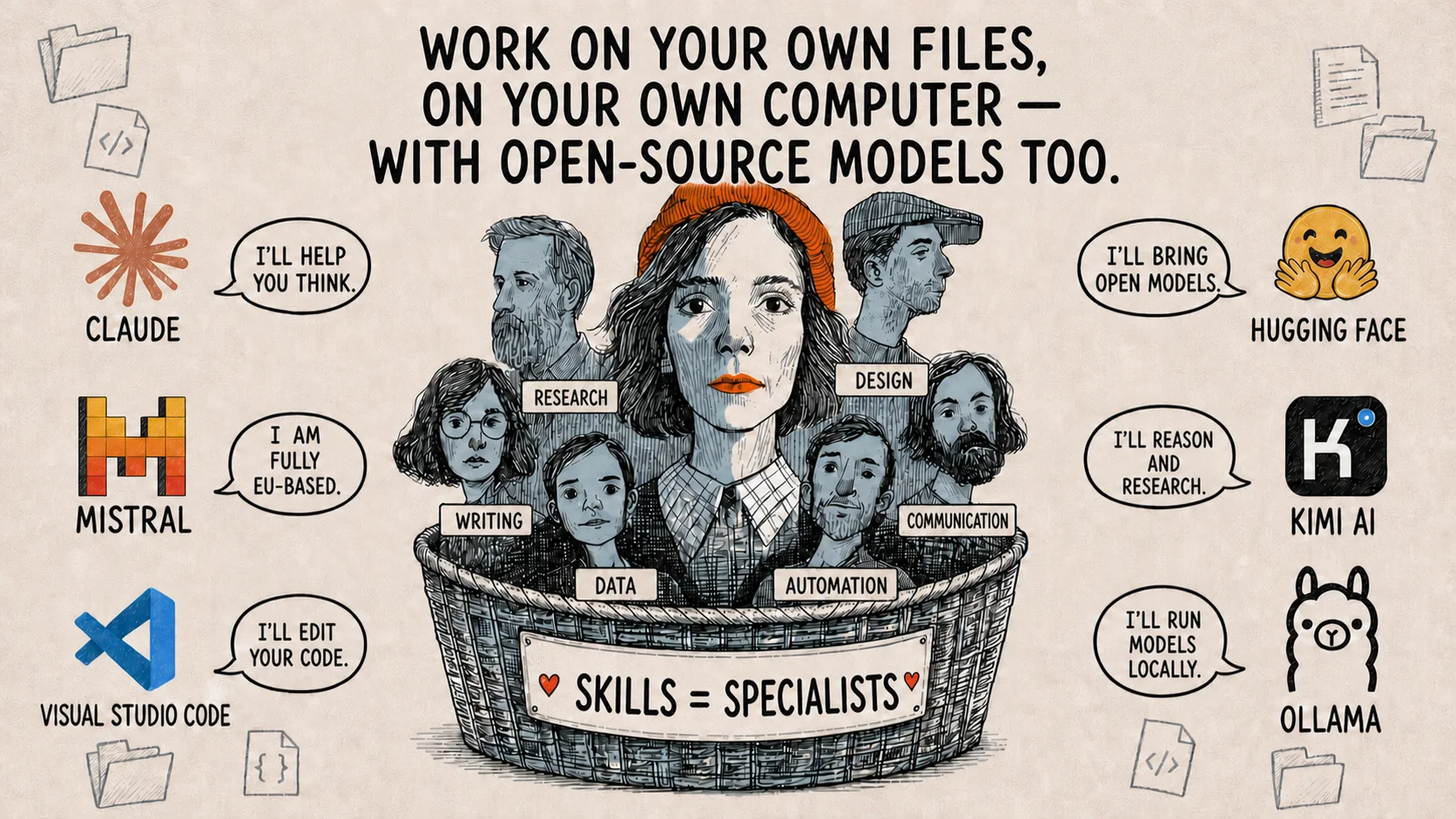
And the model is a component, not the commitment. What you are handed at the end is a folder: your instructions in plain language, the scripts that do the work, your data. An open-weight model on hardware in your own building will run it. So will Mistral, or a frontier model, if that is what the work turns out to want. The choice stays reversible.
Already running this way
Four systems built on the same principle, in four rooms that have nothing else in common.
A sales system, on the client's own hardware
Business development
6,675 prospects researched and profiled on a machine standing in the building. Open-weight models do the bulk of the reading and writing; a frontier model is called across one auditable boundary, with identifying detail held back.
A law firm's document set
Litigation · The hardest version
High volume, high stakes, and a privilege requirement that rules out the cloud entirely: the version of this problem where sending a file outside ends a career. It was built there first, which is why the rest of this page is not a promise.
Bomza
Building regulations · South Africa
Building plans verified against a published national standard, with every finding traced back to the clause it comes from.
EntityVault
Entity management · Consent-based sharing
Tokenised storage and consent-based collaboration, so records can be shared between parties without exposing the underlying data to any of them.
What you would need to bring
The work you already repeat. A few examples of it done properly. The software you already licence. And a person who can tell a right answer from a wrong one. That last one does not go away. Checking the output is the new job, and it is the part worth being clear about.
Engagement
Three stages, each one a decision point rather than a commitment to the next. The same three whatever the trade.
Diagnostic
€600 per day
One to two days for a simple project; up to two weeks for a larger build, such as a whole set of chambers. We look at your real documents and the way the work actually moves, and tell you what this would and would not do for you. Credited in full against the build if you proceed.
The build
From €7,000
Larger builds, such as a whole set of chambers, are priced well above this. The diagnostic fee is credited against the final build. Custom build, scoped after the diagnostic. Excludes hardware. The figure is an estimate based on builds we have already delivered, not a quote. Typically four to eight weeks from sign-off to a system running on your premises.
Ongoing
10–20% p.a.
Of the build price, with a minimum of €200/month. Agreed during the project, not fixed up front. Covers ingestion of new matter files, system maintenance, and keeping Pythia current as your work evolves.
Hardware, bought by you and specified by us
- EntryApple Mac mini, from about €2,000
- StandardNVIDIA DGX Spark, about €4,800
- Mac alternativeApple Mac Studio, from about €3,000; the memory needed for larger document sets costs considerably more
Indicative retail prices including VAT, checked September 2026. We specify the configuration after the diagnostic.
If your constraint is privilege
There is a page written for litigation in particular: disclosure sets, cited answers, and the audit checks that go with them.
On the name
The Pythia was the Oracle at Delphi - the one you consulted when you needed an answer from everything that had been heard.
Pythia was the title given to the high priestess of the Temple of Apollo at Delphi, who served as its oracle. The name derives from Python, the serpent Apollo slew at Delphi. To put a question to the Pythia was not to ask for a guess - it was to receive the distilled answer from everything the oracle had witnessed and absorbed. That is the model: every document, read; every question, answered from the record itself.
What is the job that eats your week?
Bring us the specific one, not the impressive one. Thirty minutes is usually enough to tell you honestly whether this is worth your time.