What Anthropic's Labor Market Research Tells Us About AI Readiness
Anthropic's landmark study of one million AI conversations reveals which roles are most exposed to AI - and what businesses should do about it.
Anthropic recently published one of the most detailed looks at how AI is actually being used in the real world. By analysing over a million conversations with Claude - with user consent - they mapped which occupations, tasks, and industries are most exposed to AI assistance right now. The findings are striking, and they carry direct implications for any business trying to plan for an AI-first future.
The Most-Used Task Categories
The first thing that jumps out is where people are spending their time with AI. Software development and coding dominate, making up well over a third of all conversations. Writing and editing come second. After that, you see a long tail of analytical, research, and creative tasks.
Share of Claude conversations by task category
Source: Anthropic Economic Index - approximate shares based on published research
This isn't just a snapshot of "what Claude users do." It's a leading indicator of where AI capability is deepest and where businesses have the most to gain - or the most to adapt to.
The Wage Exposure Inversion
One of the more counterintuitive findings in the research: AI exposure is highest for high-wage workers, not low-wage ones. The jobs most likely to involve AI-augmentable tasks are software engineers, lawyers, financial analysts - roles that command top-quartile salaries.
AI exposure index by wage quartile (higher = more exposure)
Software engineers, lawyers, analysts
Nurses, technicians, educators
Admin assistants, sales reps
Retail, food service, manual labour
Source: Anthropic Economic Index - index values are illustrative of relative ordering reported in research
This inverts the usual automation narrative. Previous waves of automation - assembly lines, basic software - displaced routine, lower-wage work. The current wave is hitting knowledge work at the top of the income distribution first. The policy and business implications are different from what most people expect.
Augmentation vs Automation
The study also breaks down how AI is being used: augmentation (the human stays in control, AI assists) versus automation (AI handles the task end-to-end). The split is roughly 57% augmentation to 43% automation.
How AI is being used: augmentation vs automation
57%
Augmentation
AI assists the human - the person remains in control and directs the output
43%
Automation
AI handles the task end-to-end with minimal ongoing human direction
Source: Anthropic Economic Index - based on task classification across sampled conversations
That's more automation than most people would guess. But the more important finding is directional: automation's share is growing. Tasks that started as augmented workflows often become automated as users develop confidence and the tooling matures.
The Capability Gap
Perhaps the most striking visualisation in the research shows the gap between AI's theoretical capability coverage across occupational categories and actual observed usage.
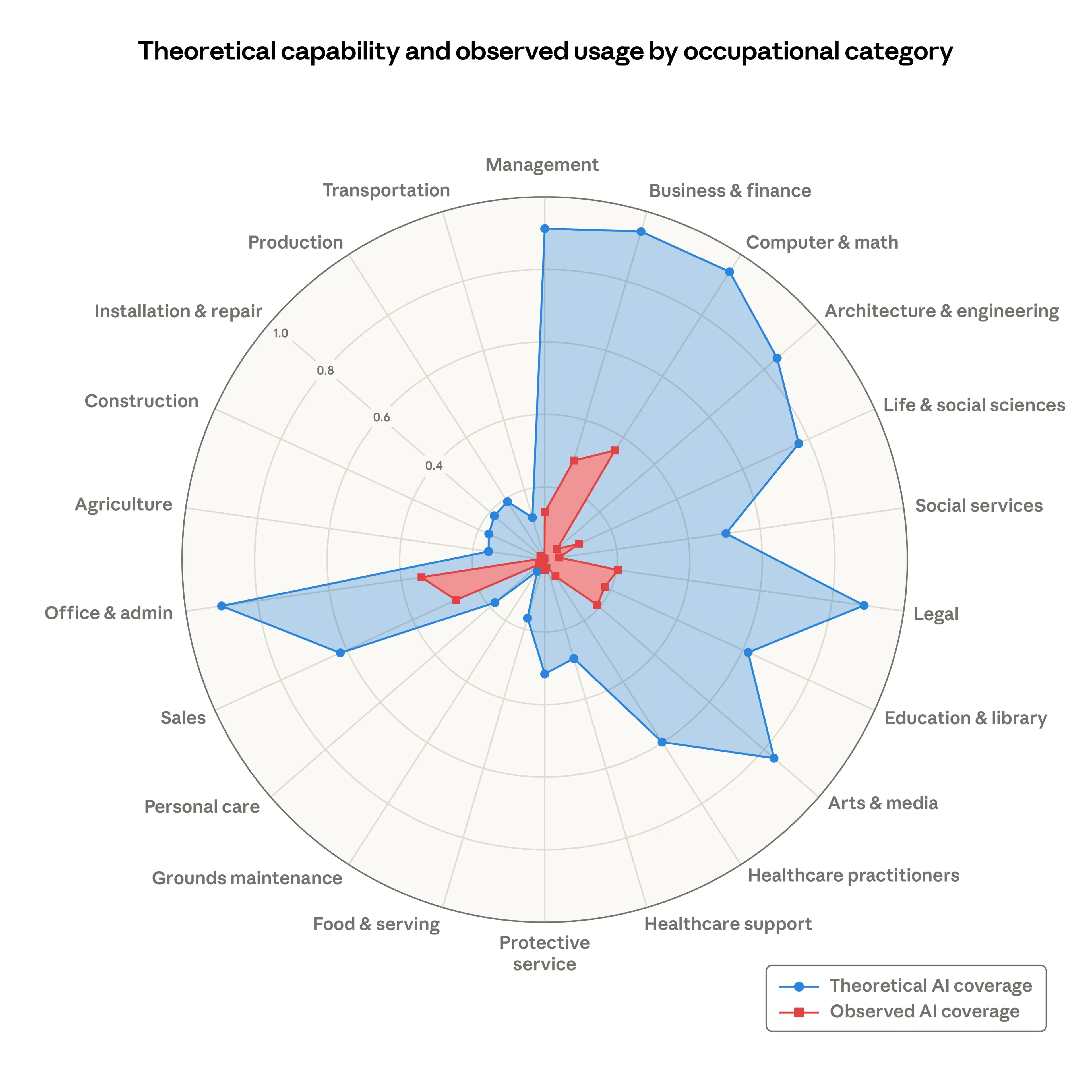
Source: Anthropic Economic Index - theoretical AI coverage (blue) vs observed AI usage (red) by occupational category
For most occupations, observed usage is substantially below theoretical coverage. People are using AI for a subset of what it could do in their role. The capability is there. The adoption - and the organisational readiness to use it - is not.
What This Means for Your Business
Three things stand out as actionable from this research.
The productivity gap is real and measurable. If your team is using AI at all, there's almost certainly a gap between what they're doing and what's possible. The research gives you a framework for where to look: which tasks in high-exposure roles are still being done without AI assistance, and why.
Augmentation is the entry point, automation is the destination. Don't wait until you're ready to fully automate a process before starting. Start with augmentation - have AI assist with the first draft, the first analysis, the initial research. Automation follows naturally as confidence builds.
Readiness is the bottleneck, not capability. The capability gap in the visualisation is a readiness gap. The AI can do more than your team is asking it to do. The constraint is structured knowledge, clear processes, and people trained to use the tools effectively.
That last point is where most of the work actually sits. And it's the work that pays the highest dividends.